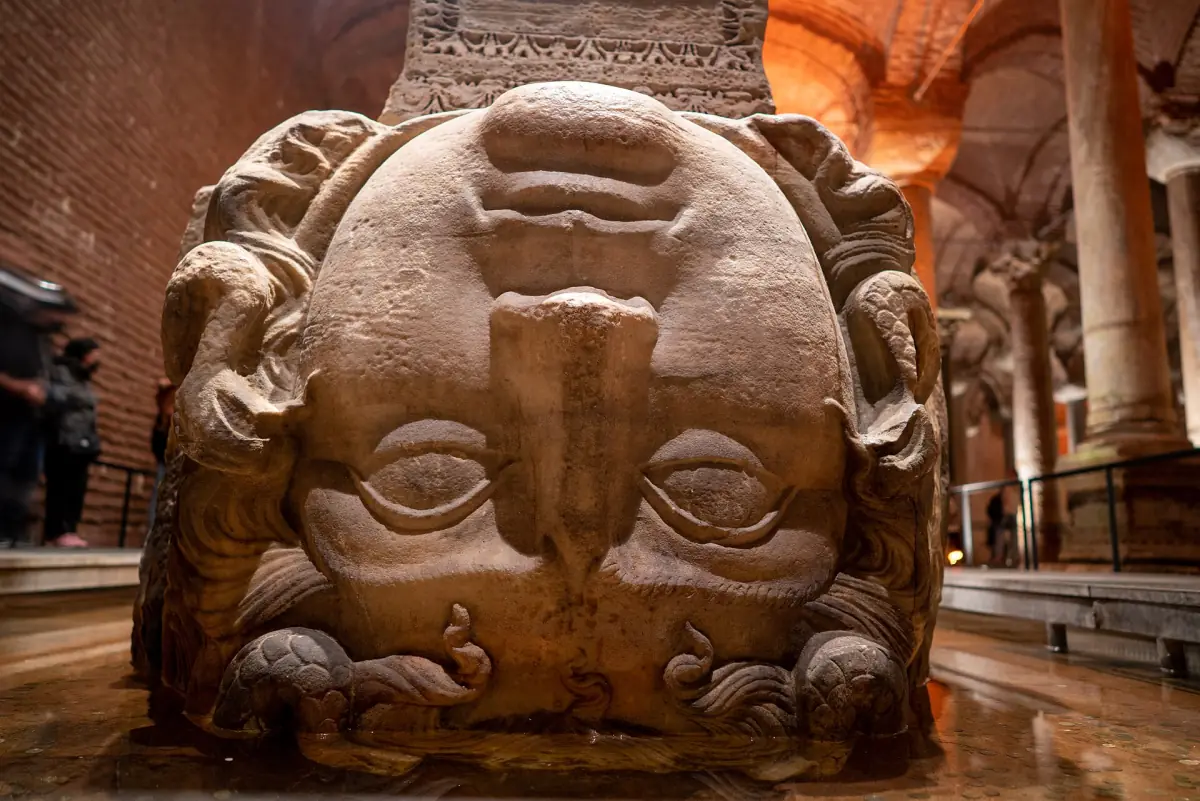
The Basilica Cistern Medusa bases in context
The Basilica Cistern Medusa carvings are two stone head blocks used as column bases. One stands upside down and the other lies sideways. Begin with that visible architectural role: the carved faces belong to supports within a water-storage building. Their unusual arrangement attracts attention, but the relationship between base and column is as useful to notice as the face itself.
The blocks were uncovered during work between 1985 and 1987, according to the historical description published in 2022. Place them within the wider hall before turning to the legends. The reservoir was built under Justinian I in the sixth century. The history guide explains its water-supply purpose, while this page concentrates on the structure and its carved elements.

Architecture and reused capitals
The historical building description published in 2022 gives dimensions of 140 × 70 m, an approximate area of 10,000 m² and a water-storage capacity of 80,000 tonnes. These are historical building figures. Read the rounded area as stated, alongside the dimensions, rather than treating it as a new calculation or a measure of the water visible during a visit.
The same account describes 336 columns, each 9 m high, arranged in twelve rows of twenty-eight with spacing of 4.80 m. That grid provides a useful framework for looking around. First follow the repeated lines of supports, then compare individual columns and capitals. Different reused materials and capitals give individual elements their own appearance within the regular arrangement of the hall.
Our pick: guided cistern visit
A licensed guide and admission make this an option for visiting the cistern and its columns.
Hand-picked tours, booked through Viator. Prices are indicative starting prices in euros (as of October 2026). Tap a tour for live availability and the current price in your currency.

Cistern admission with a licensed guide
A general guided visit with admission, for looking at the heads, columns and wider building in context.
A guided visit to the cistern
The visit option featured here includes admission to the Basilica Cistern and a professional licensed guide. It suits visitors who prefer live explanation during the visit rather than preparing only with a written guide. The product is a general cistern visit: choose it for entry and guiding, with the heads and the broader architecture as your own interests within the building.
For the meeting arrangement, use the booking instructions for the bus stop on Sultanahmet Square marked with the letter D. Allow time to find the meeting place before the guided visit. The tour comparison helps distinguish a cistern-focused visit from a wider Old City route; the ticket page covers admission and audio formats.
Medusa: building block and legend
In mythology, Medusa belongs to stories involving Athena, Perseus and petrification. Those stories are a way of approaching the subject of the carving. Keep them distinct from an explanation of why a particular block was placed sideways or upside down. A mythological narrative can be memorable without serving as a construction record for the reservoir.
When looking for the Medusa head in Istanbul, approach the carving as both an image and a reused building element. Look at the face, its orientation and its position beneath the column. Treat accounts of the reason for that orientation as legends rather than a settled explanation. The physical arrangement is visible; a story about the builders’ intention needs a different kind of evidence.
The reuse of carved stone also helps connect these bases to the other capitals and materials in the hall. Avoid assigning every element to a single earlier building. The interest lies in seeing how different pieces were brought into a repeated structural arrangement, and how a recognisable carved subject became part of the support for a column.
Art and lighting in 2025
A description published on 18 July 2025 records light and sound installations, temporary exhibitions and cultural events at the cistern. This adds a modern cultural chapter to the building’s earlier role as a reservoir. Read that dated account as a description of activity in 2025, and choose any present-day event from its own dated programme.
Lighting and reflections can draw attention to the spacing of the supports and the forms of the stonework. The photograph on this page shows an eye-carved column with illumination; its caption describes that motif. To compare a different cistern interior, continue to Şerefiye and Binbirdirek. For the timing of this visit, use the separate seasonal opening-hours guide.
Frequently asked questions
How many Medusa head bases are there?
There are two head blocks used as column bases. One is sideways and the other upside down; their uncovering is dated to work between 1985 and 1987 in the historical description.
How are the columns arranged?
The historical account gives 336 columns in twelve rows of twenty-eight. It describes them as 9 m high, with spacing of 4.80 m.
Does the featured visit include a guide?
It includes cistern admission and a professional licensed guide. It is a general guided visit to the cistern rather than a separate specialist course on the Medusa carvings.